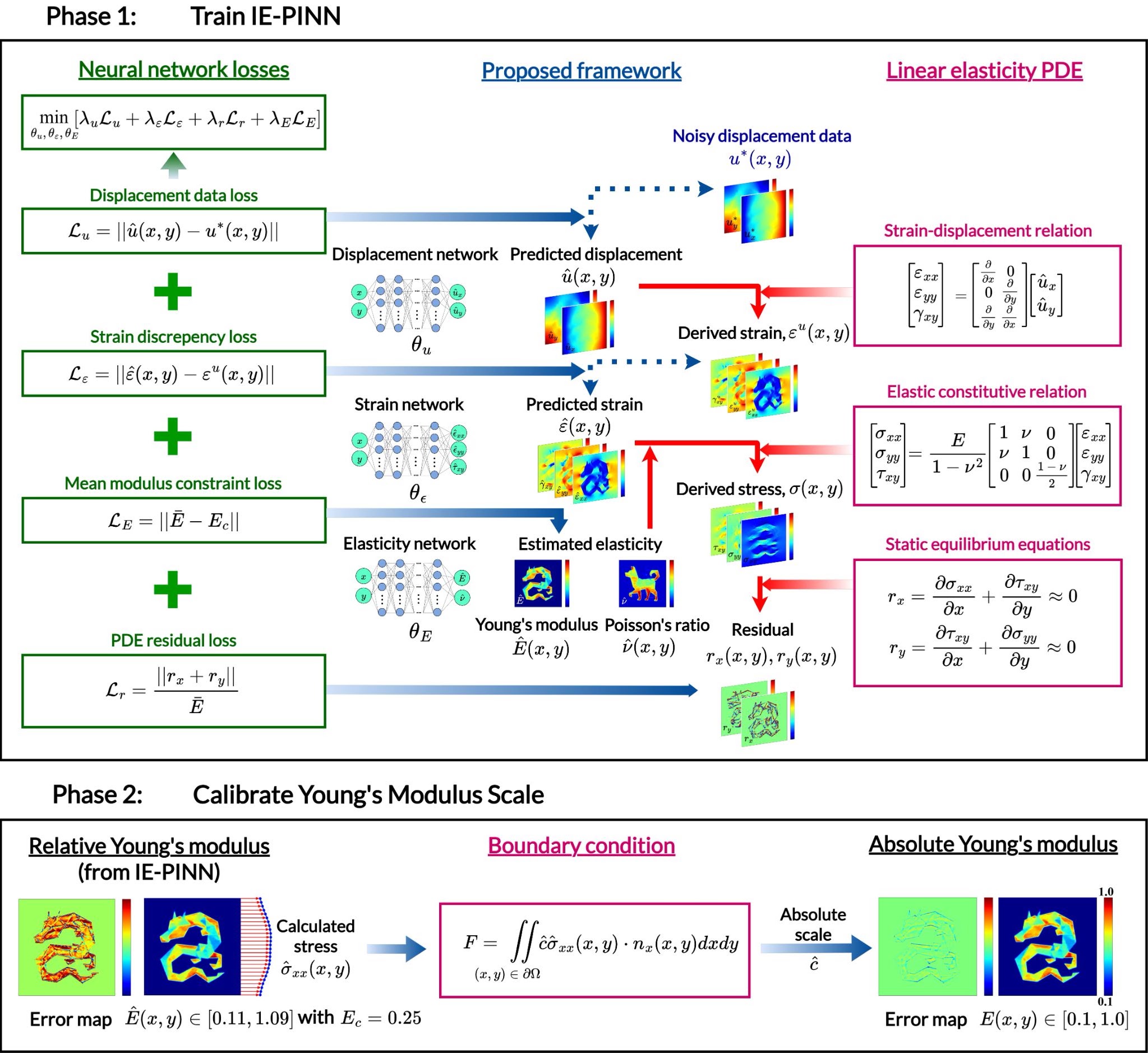
Physics-Informed Machine Learning to estimate heterogeneous stiffness (elastic moduli) of bones based on the bone deformation data
Goal: To infer the unobserved underlying elastic properties based on observed noisy deformation data using the law of physics (partial differential equation; PDE).
Methodologies: Physics-Informed Neural Network, deep neural network
PDE Equation: Linear Elasticity with heterogeneous elastic moduli
Collaborators: This work is done with a Ph.D. students, T. Srikitrungruang, S Aghaee, an undergraduate student, M. Lemon, and Collaborator, Dr. Yuxiao Zhou.
Publications
[J10] Tatthapong Srikitrungruang (advisee), Sina Aghaee Dabaghan Fard (advisee), Matthew Lemon (advisee), Jaesung Lee*, and Yuxiao Zhou, “Robust Physics-Informed Neural Network Approach for Estimating Heterogeneous Elastic Properties from Noisy Displacement Data,” Advanced Science, vol. 12, no. 48, article e08445, 2025, Published online 2025-11-25, doi:10.1002/advs.202508445.
Publication record: [J10]
- Advanced Science is a premier interdisciplinary journal with high impact (IF > 14).